Showing posts with label Technology. Show all posts
Showing posts with label Technology. Show all posts
Friday, March 16, 2018


Thursday, July 18, 2013
Next Draft? Every Day!
Dave Pell's genius is picking and packing the day's buzz-worthy news into a smart set of talking points for your evening dinner party. Check out Next Draft, it's Water Cooler Cool...
Here's the Next Draft splash page.
And pasted below is an example of what you'll be getting when you sign up.
ENJOY!
Here's the Next Draft splash page.
And pasted below is an example of what you'll be getting when you sign up.
ENJOY!
|


Monday, April 1, 2013
The Recent DDoS Attacks on Banks: 7 Key Lessons Learned
Here’s a good recap of the recent
Distributed Denial of Service (DDoS) attacks on banks, for anybody who hasn’t followed the mounting Cyber Security threat.

What should banks large and small learn from the DDoS
attacks that crippled websites and shook consumer faith in the industry?
Here’s what Rodney Joffe,
Starting in mid-September, one of the largest and most
sophisticated DDoS attacks ever targeted the titans of American banking.
Initially, victims included Bank of America, JPMorgan Chase, Wells Fargo, PNC
Bank, and U.S. Bancorp. In the weeks to come, others would also feel the pain.
Websites crashed, customers were unable to make transactions and IT
professionals and PR gurus went into panic mode. Leon Panetta, then-U.S. Secretary
of Defense, said the attacks foreshadowed a “Cyber Pearl Harbor.” While
evidence still continues to emerge, the following lessons are clear enough. All
spell danger, for banking and the world in general.
1. DDoS
attacks have entered a dangerous new phase. A combination of size
and intelligence marked these attacks. While they peaked at between 60 and 150
Gbps (most DDoS attacks are smaller than 1 Gbps), the assaults on banks
involved only 2,000–3,000 computers, not the tens or hundreds of thousands we’ve
seen in botnets before. The difference: most of the compromised systems were
powerful business machines, rather than traditional home computers, with access
to significantly more bandwidth to help flood connections. First, the attackers
hit web resources with large numbers of HTTP (web) traffic and then moved on to
DNS servers, which tend to be more vulnerable. The result was a curious hybrid:
a highly strategic, brute-force attack that left its victims reeling. Clearly,
the attackers were well acquainted with how the Internet works.
2. Who did it and why are less important than the fact it could be done. An Islamic group calling itself the Cyber Fighters of
Izz ad-din Al Qassam claimed credit for the attacks, allegedly retaliating for
an anti-Muslim video. While some suspect the hand of Iran behind these
concerted strikes, no one has provided definitive proof of the culprits’ identities
or motives. It’s possible a nation-state or terrorist cell is guilty. It’s also
possible for the proverbial basement genius to have done it. And that’s the
scariest part. Anyone with sufficient knowledge could have pulled this off.
Whoever it was didn’t need millions of dollars or a global support network. If
you truly know how the Internet is architected, you can succeed in taking down
whole industries, no matter who you are and whatever your reasons may be.
3. Brand
reputations have suffered. So far, nobody has reported stolen data or major
revenue losses, though of course most organizations are in no rush to admit
such breaches. Unquestionably, however, America’s largest banks have lost a
measure of public trust. Online forums lit up as website outages dragged on.
Bank customers wondered aloud about security readiness. Some feared for their
data and ultimately their money. As September rolled into October, there were
concerns about defaulting on mortgage payments and other monthly bills because
customers couldn’t log in to their bank accounts. While some banks did a good
job of keeping customers apprised, no one had reassuring news. The best they
could do was spin.
4.
Traditional DDoS protection proved to be ineffective. Most
companies rely on firewalls and intrusion detection/ protection systems to
repel DDoS attacks. Some even have their own DDoS mitigation appliances, though
many lack the trained staff to wield them effectively. When banks got socked by
malicious HTTP traffic, firewalls may have worked to a point but finally turned
into bottlenecks. And when enormous amounts of bad DNS traffic showed up, it
was game over. Traditional systems simply were not up to the task. Pipes got
flooded, outages occurred and the cavalry was called in – third-party DDoS
protection specialists with cloud-based solutions affording more bandwidth and
a better chance of success.
5. Smaller banks weren’t hit, but are more vulnerable. Think about it. The largest banks have the budgets to
spend on DDoS protection. While their solutions couldn’t stop these recent
attacks, they can stop most – the 90% less than 1Gbps in size. Small banks, on
the other hand, lack the protection to stop even these. A modest-sized attack
can cripple their operations. This makes local and regional banks extremely
vulnerable. Third-party solutions, especially affordable on-demand services,
are a good bet for smaller players who cannot build their own.
6. The attacks demonstrated the need for holistic DDoS protection. It’s not nearly enough to have a customized firewall
or a mitigation appliance, especially one nobody has thought to tune in months.
To repel today’s attacks you also need enormous bandwidth, skilled mitigation
staff and diverse technologies, a mix that stops both HTTP and DNS attacks
along with the application-layer attacks that have become so popular. In other
words, you have to be ready for anything. Building on the bank attacks, the
next wave of DDoS will surely be comprehensive – in strategy, tactical skill
and destructive power.
7. The Internet itself was the attackers’ arsenal. Yes, for years now DDoS attackers have marshaled
botnets to do their bidding. But the bank attackers showed an unprecedented
understanding of the Internet’s potential as a kind of weapons storehouse.
Everything they needed was out there for the taking: high-capacity servers,
bandwidth galore and information on the business networks in their crosshairs.
The attackers showed great patience and impressive intelligence gathering. They
clearly learned from past attacks and successful defenses. Their own success in
taking down the nation’s largest banks will prove to be an “Aha!” moment for
aspiring miscreants. Knowing there is no protocol to stop attacks at their
sources, future attackers likewise will plunder the Internet, cobbling together
the resources and bandwidth to flood pipes, take down websites and leave business
giants helpless.
Last thought: The banking industry leads the world in protection and
security practices. If these attacks could happen to banks, they can happen to
anyone. They truly are a when, not an if.
H/T: RT
Sunday, January 27, 2013
World Map Composed of Flags?
 |
| Mosaic World Map |
I found this creative world map here.
Hongkiat describes the work as a mosaic of flags, which is an idea that appeals to me. Unfortunately, that is not an accurate description of the work. Fortunately, Hongkiat was careful to cite the original source, Genista.
Genista offers a detailed look at the tiles that compose the world map, as well as a link to the color sorting program that arranged the tiles in an optimal map. Have a look here.
I find the work of Genista and the Long Line collaborators endlessly fascinating and I'm delighted to share this with PhilosFX readers.
But I still want to see a world map that really IS composed of Flags...
Tuesday, October 2, 2012
Want a decent life?

“Work hard and play by the rules.” --Bill Clinton in 1992
That was then--before the Internet and globalization.
This is now... these are the New Rules...
This is now... these are the New Rules...

"The truth is, if you want a decent job that will lead to a decent life today you have to:
- work harder,
- regularly reinvent yourself,
- obtain at least some form of post-secondary education,
- make sure that you’re engaged in lifelong learning,
- and play by the rules."

“We have to prepare more Americans for the new jobs that are being created in a world fueled by new technology. That’s why investments in our people” — in more community colleges, Pell grants and vocational-training classes — “are more important than ever.”
--Clinton at the Democratic National Convention, 2012, as quoted by Friedman
Questions:
- Are you prepared to work harder to earn a decent life for yourself and your children?
- What have you done to reinvent yourself, lately?
- How are you fostering the value of life-long learning within yourself and those closest to you?
- Should we be teaching computer programming to our elementary school students?
Read Freidman's NY Times article here: New Rules/
Friday, September 28, 2012
Track our progress on the 1K in 1 Day Challenge
Folks,
The 1 K in 1 Day Challenge is here!
We leave Sat Sept 29 at 9:00 am Eastern and we aim to complete a 1000 mile course in under 24 hours. Not only are we attempting to gain entry into the Iron Butt Association, we are also raising funds and awareness for Not Alone, and organization helping veterans dealing with PTSD.
Our Road Captain, Keith DeNinno, has a GPS. Once we get started, you can follow our progress!
Saturday, September 1, 2012
How many blogs are there?

I recently discovered that PhilosFX has climbed 4 million places in the blog rankings, from 24 millionth place up to 20 millionth. OK, so PhilosFX is not a risk to unseat the #1 blog, the Huffington Post, anytime soon. That's perfectly OK with me. I like where we're at, I am thrilled you are here reading along, and I am delighted with the positive feedback that we're moving up.
To me, that 4 M climb looks like a big number and therefore, one could assume, a good thing. Up is Good! But of course, I wanted to know just how good is this good thing? Going from 24th to 20th is only a 20% jump if we started in last place. How many blogs are there, anyway? I need a denominator! Climbing 4 million positions out of 10 million blogs is a big 40% jump. Climbing 4 million out of 100 million is not so impressive. Climbing 4 out of 1,000 is zzzz.
Based on a survey of various sites out there, I would say that it must be very difficult to count the number of blogs! Estimates vary wildly. It looks like the number is closer to 200M than 100 or 300.
- About 200M, projected from 181M in Dec 11, 173M in Oct 2011 and 79M in Oct 2008. http://blog.nielsen.com/nielsenwire/online_mobile/buzz-in-the-blogosphere-millions-more-bloggers-and-blog-readers/
- About 200M, projected from 184M at the end of 2008. http://www.quora.com/How-Many-X-Are-There-In-The-World/How-many-blogs-are-there-on-the-Internet
- About 200M, projected from 70M in Jul 2005. http://wiki.answers.com/Q/How_many_blogs_are_there_in_the_world
Interesting
- The State of the Blogosphere. http://technorati.com/social-media/article/state-of-the-blogosphere-2011-introduction/
- Top Ten Blogs Ranked by Traffic. http://technorati.com/blogs/top100
- Top Ten Showing Web Publishing Platform. http://royal.pingdom.com/2012/04/11/wordpress-completely-dominates-top-100-blogs/
| Rank | Name | URL | CMS |
|---|---|---|---|
| 1 | The Huffington Post | huffingtonpost.com | Movable Type |
| 2 | Mashable! | mashable.com | WordPress – self-hosted |
| 3 | BuzzFeed | buzzfeed.com | Custom |
| 4 | The Daily Beast | thedailybeast.com | N/a |
| 5 | The Verge | theverge.com | Custom |
| 6 | TechCrunch | techcrunch.com | WordPress – hosted |
| 7 | Engadget | engadget.com | Blogsmith |
| 8 | Gizmodo | gizmodo.com | Gawker |
| 9 | Think Progress | thinkprogress.org | WordPress – self-hosted |
| 10 | Ars Technica | arstechnica.com | Custom |
So here at PhilosFX we are not swimming with the sharks just yet. There are 20M blogs that get more traffic than this one. Fine. We may not be in the "Top 10", but being ranked at 20 of 200 puts us up in the top 10%!
And that's a good thing.
Tuesday, August 21, 2012
Cause - The PhilanthroPub

Here is an idea I can really get behind: a not-for-profit pub!
The concept is simple and brilliant. Patrons come to the pub and have a good time. Then all the net profits are donated to vetted charities. If nothing else, patrons will feel a little less guilty about their hangovers...
Cause changes the way the world looks at charitable giving. The Cause model makes giving more convenient, fun, and transparent for the general population. By bringing charitable giving into day to day living, Cause will break down barriers and allow more and more people to be involved. At the same time, Cause will provide much-needed exposure and funds for featured organizations, allowing them to scale their impact to beneficiaries they had not previously been able to reach.
The entrepreneurs behind the "Philanthro Pub" idea have big dreams for the future of their venture.
Cause Washington DC is only the beginning. We think that we are onto something big and have a model that can go global. We hope to franchise the model and see Causebars around the world, continuing to create impact in this unique manner. We also feel that there are numerous expansion possibilities, including Cause bookstores, Causecoffee shops and more. We hope that this brief introduction gets you as excited aboutCause as we are. For more information or to get involved, please contact us.
Cause is coming soon to 1926 9th Street NW, Washington DC 20001
More info: Cause - The PhilanthroPub
I doff my hat to Margot, who brought this innovative idea to my attention!
Sunday, July 29, 2012
Broken Spoke Camping at the Motorcycle Rally in Sturgis
Map of the Broken Spoke Campgrounds
I posted this link to my blog mainly so I could access it from my phone when I arrived to the campsite! Ah, technology...
Of course, to produce the handy version you see below (and save you clicking in the link), I had to download the .pdf, open Adobe, take a screen shot, paste the screen shot as a bitmap into PowerPoint, save the bitmap as a picture, and then upload the picture to the blog.
Sheesh! How 20th Century!

I posted this link to my blog mainly so I could access it from my phone when I arrived to the campsite! Ah, technology...
Of course, to produce the handy version you see below (and save you clicking in the link), I had to download the .pdf, open Adobe, take a screen shot, paste the screen shot as a bitmap into PowerPoint, save the bitmap as a picture, and then upload the picture to the blog.
Sheesh! How 20th Century!

Friday, May 18, 2012
What "Professional" means in the age of Social Media
A new definition of professional behavior is developing in this social media-driven world. I think the table below captures the dynamic clearly. Where do you see yourself on the continuum of professional behavior? Are you leading the pack, keeping up with developments. or lagging behind? What does this changing dynamic portend for our country, our economy, our families?
How clearly one sees the divide between Old and New professional behavior might be a function of one's age and experience. In my personal case, as a field grade Army officer, I am positioned between the younger company grade Captains and the more senior General Officers. In my observation, junior officers uniformly exhibit the New Professional ethic. What is interesting to me is that the Army is so resilient and so adaptable, that the majority of General Officers are also embracing social media. The Chief of Staff of the Army, GEN Ray Odierno, tweets on Twitter and posts on Facebook.
Where I see a rub is in some of the old-school field grade officers, who mistrust social media--and often fer very good reason! They prefer secure email for a private, auditable record of communication. I get that. With all of the privacy concerns surrounding unwelcome advertisements via data hounds supporting Facebook and Google, I certainly get that.
My perspective as a career Army officer is one dimension of the professional divide. I am also a family man, so I think a personal divide applies. I am a Dad to two teen-aged daughters, with whom my primary means of communication is the sound-bite of an SMS text message: the kind one must delete daily to prevent one's phone from "clogging up." How impersonal and remote that feels to me! At the same time. I have parents who prefer phone calls, so I call my folks who never text and text my kids who never call, and spend the rest of my time in the in-between.
If you follow that generational communication trajectory I just laid out, where does it lead? What does it portend for our country, our economy, our families--our world?
I have no clear predictions to offer but my thought is this: I aim to remain relevant. I see the decision to stop at least trying to keep up as akin to death. Everything living changes.
Please read Allison Fine's excellent blog post HERE
H/T: Scott over at Nestler Analytics.
 |
| Original table appears in the Harvard Business Review Blog |
How clearly one sees the divide between Old and New professional behavior might be a function of one's age and experience. In my personal case, as a field grade Army officer, I am positioned between the younger company grade Captains and the more senior General Officers. In my observation, junior officers uniformly exhibit the New Professional ethic. What is interesting to me is that the Army is so resilient and so adaptable, that the majority of General Officers are also embracing social media. The Chief of Staff of the Army, GEN Ray Odierno, tweets on Twitter and posts on Facebook.
Where I see a rub is in some of the old-school field grade officers, who mistrust social media--and often fer very good reason! They prefer secure email for a private, auditable record of communication. I get that. With all of the privacy concerns surrounding unwelcome advertisements via data hounds supporting Facebook and Google, I certainly get that.
My perspective as a career Army officer is one dimension of the professional divide. I am also a family man, so I think a personal divide applies. I am a Dad to two teen-aged daughters, with whom my primary means of communication is the sound-bite of an SMS text message: the kind one must delete daily to prevent one's phone from "clogging up." How impersonal and remote that feels to me! At the same time. I have parents who prefer phone calls, so I call my folks who never text and text my kids who never call, and spend the rest of my time in the in-between.
If you follow that generational communication trajectory I just laid out, where does it lead? What does it portend for our country, our economy, our families--our world?
I have no clear predictions to offer but my thought is this: I aim to remain relevant. I see the decision to stop at least trying to keep up as akin to death. Everything living changes.
Please read Allison Fine's excellent blog post HERE
H/T: Scott over at Nestler Analytics.
Wednesday, May 2, 2012
1337: How to Read and Write "LEET"

Here's another in a series of blog posts highlighting my ongoing attempt to master irrelevant skilz. Or, for those of you who already speak 1337, I should have written,
$k!L2
If you are intrigued or simply want to know more, follow this link to the wikiHow article, How to Read and Write 1337 in 12 steps
Maybe after you read about 1337, some of the vanity plates and Twitter tags you see around will make more sense to you. Perhaps you will even be able to appear hip when texting teens and twenty-somethings.
You're welcome!
PS--The vanity license plate on the BMW at the top of this post says H4X0RZ, or Hackers.
Thursday, March 29, 2012
Neo Lebowski
Do you like both the Matrix and the Big Lebowski? Me, too. This is the best mashup I have seen.
"That rug really tied the Matrix together, man."
H/T: SR
"That rug really tied the Matrix together, man."
H/T: SR
Wednesday, March 21, 2012
Apple, America and a Squeezed Middle Class
From NYTimes.com comes this story: Apple, America and a Squeezed Middle Class
KEY QUESTION:
Is this a condemnation of our education system? Or is this an indication that all we really did after the Civil War was push our slavery overseas?
“We shouldn’t be criticized for using Chinese workers,” a current Apple executive said. “The U.S. has stopped producing people with the skills we need.”
What remains unknown, however, is whether the United States will be able to leverage tomorrow’s innovations into millions of jobs.
In the last decade, technological leaps in solar and wind energy, semiconductor fabrication and display technologies have created thousands of jobs. But while many of those industries started in America, much of the employment has occurred abroad. Companies have closed major facilities in the United States to reopen in China. By way of explanation, executives say they are competing with Apple for shareholders. If they cannot rival Apple’s growth and profit margins, they won’t survive.
“New middle-class jobs will eventually emerge,” said Lawrence Katz, a Harvard economist. “But will someone in his 40s have the skills for them? Or will he be bypassed for a new graduate and never find his way back into the middle class?”
"The Chinese government had agreed to underwrite costs for numerous industries, and those subsidies had trickled down to the glass-cutting factory [that did the work for Apple]." No doubt much of the other benefits China offers Apple are also courtesy of the Chinese government.
KEY QUESTION:
Is this a condemnation of our education system? Or is this an indication that all we really did after the Civil War was push our slavery overseas?
Thursday, March 15, 2012
Joe Tucker: The Quiet Kingmaker at Rate Beer
 |
| The Quiet Kingmaker | Dining | North Bay Bohemian |
A very interesting article about RateBeer and its creator, Joe Tucker, was published in the North Bay Bohemian, Dining section. Joe's a friendly geek with a passion for data and beer. Everybody in beer knows him, even though he actively avoids the spotlight. That's why it was good to see that some one (Kevin Weaver) in the Bay Area (San Francisco, not Chesapeake) finally pinned the man down for an interview.
Weaver discloses that he has served as a site Admin on RateBeer and has used RateBeer to publish his personal beer reviews and ratings. This insight as a customer, producer,
The Wisdom of Crowds vs The Cult of Personality
This calls to mind one of my favorite books, The Wisdom of Crowds by James Surowiecki. Joe Tucker would agree with Surowiecki's premise that "all of us are smarter than any one of us." Such egalitarianism is one of the reasons I love beer. Compare beer rating culture to that of wine. Wine ratings are heavily influenced by a few oenophiles (ahem, Robert Parker, cough cough).
"Instead of beer scores being generated via a single person or a small panel of experts, the overall scores on RateBeer are calculated as an aggregate of user-submitted scores, giving an equal weighting to every person who submits a review..."
Compares RateBeer to Beer Advocate (no mention of BeerPal)
"RateBeer is one of the two major collectors of online beer reviews, the other being Boston-based website BeerAdvocate.com. Anyone of legal drinking age may sign up for a free user account at either site and post his or her own reviews of, essentially, any commercial beers in existence. RateBeer has the larger of the two databases, with over 120,000 beer listings, an international ensemble of 75-plus regional beer experts charged with curating the site and, at latest count, over 3.5 million user-submitted beer reviews."
Meanwhile, at BeerPal, there are currently 44,000 beers and 5,600 breweries from 179 countries with 136,800 reviews in the Beer Vault. We are smaller, but our discussion forum is much friendlier. We have a great mix of thought leadership and camaraderie. I have memberships at RateBeer and BeerAdvocate, but I hang out at BeerPal.
Compares RateBeer to Amazon and Yelp
"In 2010, a Scientific American article regarding online rating sites singled out RateBeer as its lone example of what's working well in distinguishing the good from the bad, while gently disparaging the built-in biases of websites like Amazon and Yelp."To me, as a data-oriented analyst and a free-thinking beer-lover, bias is a big deal. Even though RateBeer is notable among ratings websites for it's attempts to limit bias, there is no getting around the fact that beer ratings are not the average of truly independent observations. Each rater has access to the ratings that other raters have given as they rate.
I keep all my tasting notes and ratings on a spreadsheet. Which means i have scraps of paper and e-notes all over the place which I them have to enter into the spreadsheet. One day I will have a web-based database accessible from any location and with any device, and my labor will drop to nil. Meanwhile, at least I have the satisfaction of knowing that my reviews are independent.
Which means that the only bias in my ratings is my own preference for Russian Imperial Stouts, Baltic Porters, Belgian Quads, and Double IPAs. And the occasional weizen eisbock. Not to mention smoked doppelbocks....
Monday, February 27, 2012
Stop What You're Doing, And Go See What Google Thinks It Knows About You
There has been a lot of debate about privacy vs. the data that for-profit companies such as Facebook and Google collect in exchange for social networking services. The idea is that companies offer a service such as file sharing, and they offer this at no charge. In exchange, they collect information about your preferences which they can sell to advertisers at a profit.
Google once famously attempted to distinguish themselves from the evil giant, Microsoft, by promising that they would never abuse your data. But the definition of abuse may be changing over time.
Are you curious to see what Google thinks it knows about you? Now you can find out! Follow the link below from your home computer, and have a look at the information Google has collected and associated with your URL.
Stop What You're Doing, And Go See What Google Thinks It Knows About You
Seven of Ten are correct and the three that were wrong are wrong for reasons I can understand.
What do you think about this data-mining effort? Good, bad, or indifferent?
Google once famously attempted to distinguish themselves from the evil giant, Microsoft, by promising that they would never abuse your data. But the definition of abuse may be changing over time.
Are you curious to see what Google thinks it knows about you? Now you can find out! Follow the link below from your home computer, and have a look at the information Google has collected and associated with your URL.
Stop What You're Doing, And Go See What Google Thinks It Knows About You
An edited printout of my results are provided below as an illustration.
Your categories
Below you can review the interests and inferred demographics that Google has associated with your cookie. You can remove or edit these at any time.
- Arts & Entertainment - [Correct]
- Music & Audio - [Wrong]
- Autos & Vehicles - [Correct]
- Beauty & Fitness - [Wrong]
- Beauty & Fitness - [Wrong]
- Games - [Correct]
- Shopping - [Correct]
- World Localities - [Correct]
Your demographics
We infer your age and gender based on the websites you've visited. You can remove or edit these at any time.
- Age: [Correct]
- Gender: [Correct]
Seven of Ten are correct and the three that were wrong are wrong for reasons I can understand.
What do you think about this data-mining effort? Good, bad, or indifferent?
Friday, December 30, 2011
Connecting Brains with Machines
I have an exciting book recommendation:
Beyond Boundaries: The New Neuroscience of Connecting Brains with Machines---and How It Will Change Our Lives (9780805090529): Miguel Nicolelis
Sex, fire, alcohol, electricity, nuclear power... There are down-sides to every advance. I am sure this technology can be abused in the wrong hands. However, I am hopeful it will be a net benefit to humanity, and the risks will be managed well.
Beyond Boundaries: The New Neuroscience of Connecting Brains with Machines---and How It Will Change Our Lives (9780805090529): Miguel Nicolelis
This book recommendation goes out to my friends at the Army Research Institute for Behavioral Sciences, my colleagues at the US Army MANPRINT Directorate, and all interested in human-systems integration for performance enhancement or for post-injury rehabilitation.
Dr Nicolelis and his team are completing neurological research in which monkeys are able to control a joystick just by thinking. That is amazing. They first mapped a monkey's thoughts as she used a joystick to get a juice treat. They then used her brain signals to power a robotic arm in another room. They "tuned" the monkey's brainwaves until the robotic arm copied the monkey's real arm. Then they removed the monkey's joystick, but not her juice treats. They brought the robotic arm and joystick into view. The monkey soon figured out how to move the robotic arm and control the joystick to get a reward, just by thinking.
This research has obvious implications for performance enhancement. Can you imagine an astronaut or a race car driver or a mechanic who is literally "at one" with his tools?
More subtle applications are doubly intriguing: imagine being a quadriplegic, like the late Christopher Reeves, or like so many soldiers and Marines returning from war. And now imagine donning an exoskeleton with robotic arms and legs which respond to signals from your brain.
Fascinating!
Fascinating!
Sex, fire, alcohol, electricity, nuclear power... There are down-sides to every advance. I am sure this technology can be abused in the wrong hands. However, I am hopeful it will be a net benefit to humanity, and the risks will be managed well.
Incidentally, to my animal-loving friends and family, the testing in these experiments was gentle on the subjects. Dr. Nicolelis intends to begin testing on human subjects in 2012. Personally, I think this is a very exciting development.
Interview with Dr. Nicolelis on the Diane Rehm Show
Dr. Nicolelis's website (includes a link to his interview with Jon Stewart)
Thursday, December 29, 2011
Connect the Dots
I really enjoyed and highly recommend the article The Key To Creativity, According To Steve Jobs: Connecting the Dots which appeared in a recent edition of Edudemic
The author points to several instances in which Steve Jobs used the analogy of connecting the dots to explain his success. He was able to see seemingly different ideas and connect them in unique ways. He points out that this skill is the essence of creativity. If Ford had asked customers what they wanted, they'd have asked for a faster horse. Creative people are not limited by evolutionary improvements. Instead, like Jobs and Ford before him, they give people what they don't even know they want yet.
Another point that resonates with me is the combination of art and science in one person. Jobs not only understood the science of technology, but he also understood the importance of design and marketing. In this way, I would describe Jobs as an architect, that profession that most perfectly blends the science of materials and function with the art of form and perception.
Read it here: The Key To Creativity, According To Steve Jobs
H/T: MGW
Saturday, December 24, 2011
Odds-On Favorite Redux
Here is a follow-up to an earlier post regarding calculating the odds of a particular country being the next to have three unique visits to PhilosFX.

b. The rising countries displaced some inactive ones more than others, depending on the date of the most recent activity. Bulgaria, Ecuador, and New Zealand fell 4, 4, and 5 positions, respectively
c. Iceland got its 2d flag and moved up 11 positions to #50, ahead of idle Georgia!
3. Big jumps in the rankings by Pakistan (43 to 38) and Portugal (46-39) within the Top 48 and more dramatically by Serbia (59 to 43) and Argentina (58 to 44) into the Top 48 caused two countries to drop out of the Top 48: Chile (47 to 49) and Georgia (48 to 51).
As a result of dramatic gains by a few countries, Saudi Arabia, formerly #45, was knocked down three positions to occupy the 48th position on the display. My pick, Georgia, still waiting for flag #3, dropped three positions to #51.
It'll all change daily, and it doesn't really matter much in the grand scheme of things.
I guess the bottom line to all of this is simple: I really like knowing that people from all around the planet have discovered PhilosFX, and many of them have come back. There are, as of this writing, about 2750 unique visitors from about 90 countries, and over 14,000 visits in all. Clearly many of the 2750 are repeat visitors.
When I was young I loved connecting to the world around me by collecting postage stamps from around the globe. In this day of electronic communication, stamps are becoming a thing of the past. These days I am watching my flag count instead, feeling somehow connected to the global stream of consciousness, and counting my many blessings.
But then again, I just like to count.

On 12 Dec, there were a total of approx 2500 flag views on the Flag Counter. (Compare that total and the picture above with the new total and current status below.)
At that time, the top 47 countries had 3 or more flag visits. There is room for 48 countries in the display, so the question was, which country would be the next to have 3 flag visits and thus fill a spot in the display?
Thirteen countries had 2 visits each, from # 48 (Georgia) shown on the screen capture above, to # 60 (Vietnam). Note: If you click on the live Flag Counter display at the bottom of the page, you can see all 90 or so countries that have one or more flags.
I commented that one of those thirteen countries with 2 flags at the time would most likely be the 48th country to boast three or more unique visits to PhilosFX. I allowed that it was also possible, but unlikely, for a country with one or fewer visits to get to three faster.
Then I posed these two questions:
1. How would you calculate the odds of any one of these countries becoming the 48th country to boast 3 or more unique visits to PhilosFX?
2. Using your approach, which country do you predict will be the 48th country to boast 3 or more unique visits to PhilosFX?
My unpublished answer:
1. The odds of any one of those 13 countries which already had 2 flags being next to get a third are about the same, approximately 0.12% each (2/2500 + 1/2500).
2. I would use momentum to weight the odds in favor of those countries with the most recent activity. Using a sliding scale, I would put Georgia's odds of being the next country to get its third flag at about 0.15%
3. The odds of a country with one flag getting two more before any of those with two get a third are remote (1/2500 * 1/2500 * 1/2500).
4. The odds of a country with zero flags getting three before any of those with two get a third are vanishingly small.
Based on this logic, my guess was that Georgia had a slight advantage to become the 48th country with two flags to get the third, which--if all else remained unchanged, would push Georgia up to 41st place and drop Chile into 48th on the display.
A week later, on 19 December, it happened! All 48 countries in the display had 3 or more flags. By then, lots of changes had taken place to the rankings in the range from 27 to 61. Nine countries in this range moved up in the rankings, only one stayed at the same position, and the remaining 15 slipped due to inactivity.
Georgia's slight advantage over the competition was not enough to produce the weakly predicted result. Here are some thoughts as to why it did not:
At that time, the top 47 countries had 3 or more flag visits. There is room for 48 countries in the display, so the question was, which country would be the next to have 3 flag visits and thus fill a spot in the display?
Thirteen countries had 2 visits each, from # 48 (Georgia) shown on the screen capture above, to # 60 (Vietnam). Note: If you click on the live Flag Counter display at the bottom of the page, you can see all 90 or so countries that have one or more flags.
I commented that one of those thirteen countries with 2 flags at the time would most likely be the 48th country to boast three or more unique visits to PhilosFX. I allowed that it was also possible, but unlikely, for a country with one or fewer visits to get to three faster.
Then I posed these two questions:
1. How would you calculate the odds of any one of these countries becoming the 48th country to boast 3 or more unique visits to PhilosFX?
2. Using your approach, which country do you predict will be the 48th country to boast 3 or more unique visits to PhilosFX?
My unpublished answer:
1. The odds of any one of those 13 countries which already had 2 flags being next to get a third are about the same, approximately 0.12% each (2/2500 + 1/2500).
2. I would use momentum to weight the odds in favor of those countries with the most recent activity. Using a sliding scale, I would put Georgia's odds of being the next country to get its third flag at about 0.15%
3. The odds of a country with one flag getting two more before any of those with two get a third are remote (1/2500 * 1/2500 * 1/2500).
4. The odds of a country with zero flags getting three before any of those with two get a third are vanishingly small.
Based on this logic, my guess was that Georgia had a slight advantage to become the 48th country with two flags to get the third, which--if all else remained unchanged, would push Georgia up to 41st place and drop Chile into 48th on the display.
A week later, on 19 December, it happened! All 48 countries in the display had 3 or more flags. By then, lots of changes had taken place to the rankings in the range from 27 to 61. Nine countries in this range moved up in the rankings, only one stayed at the same position, and the remaining 15 slipped due to inactivity.
Georgia's slight advantage over the competition was not enough to produce the weakly predicted result. Here are some thoughts as to why it did not:
1. The list is volatile. Only one country (Israel) out of 35 in this range did not move up or down in the rankings.
2. At the low-volume end of the spectrum, small increases of just one flag can produce fairly wide swings in the rankings.
a. Biggest rank gainers: Serbia and Argentina went from 2 flags to 3 and climbed 16 and 14 positions, respectively.
2. At the low-volume end of the spectrum, small increases of just one flag can produce fairly wide swings in the rankings.
a. Biggest rank gainers: Serbia and Argentina went from 2 flags to 3 and climbed 16 and 14 positions, respectively.
b. The rising countries displaced some inactive ones more than others, depending on the date of the most recent activity. Bulgaria, Ecuador, and New Zealand fell 4, 4, and 5 positions, respectively
c. Iceland got its 2d flag and moved up 11 positions to #50, ahead of idle Georgia!
3. Big jumps in the rankings by Pakistan (43 to 38) and Portugal (46-39) within the Top 48 and more dramatically by Serbia (59 to 43) and Argentina (58 to 44) into the Top 48 caused two countries to drop out of the Top 48: Chile (47 to 49) and Georgia (48 to 51).
As a result of dramatic gains by a few countries, Saudi Arabia, formerly #45, was knocked down three positions to occupy the 48th position on the display. My pick, Georgia, still waiting for flag #3, dropped three positions to #51.
It'll all change daily, and it doesn't really matter much in the grand scheme of things.
I guess the bottom line to all of this is simple: I really like knowing that people from all around the planet have discovered PhilosFX, and many of them have come back. There are, as of this writing, about 2750 unique visitors from about 90 countries, and over 14,000 visits in all. Clearly many of the 2750 are repeat visitors.
When I was young I loved connecting to the world around me by collecting postage stamps from around the globe. In this day of electronic communication, stamps are becoming a thing of the past. These days I am watching my flag count instead, feeling somehow connected to the global stream of consciousness, and counting my many blessings.
But then again, I just like to count.
Sunday, November 6, 2011
5 million terabytes of data weighs 0.2 millionths of an ounce
Fascinating video answers the question: How much does the Internet weigh?
Hat tip: MCRWS
Hat tip: MCRWS
Friday, October 28, 2011
How Recruiters Use Social Networks to Screen Candidates
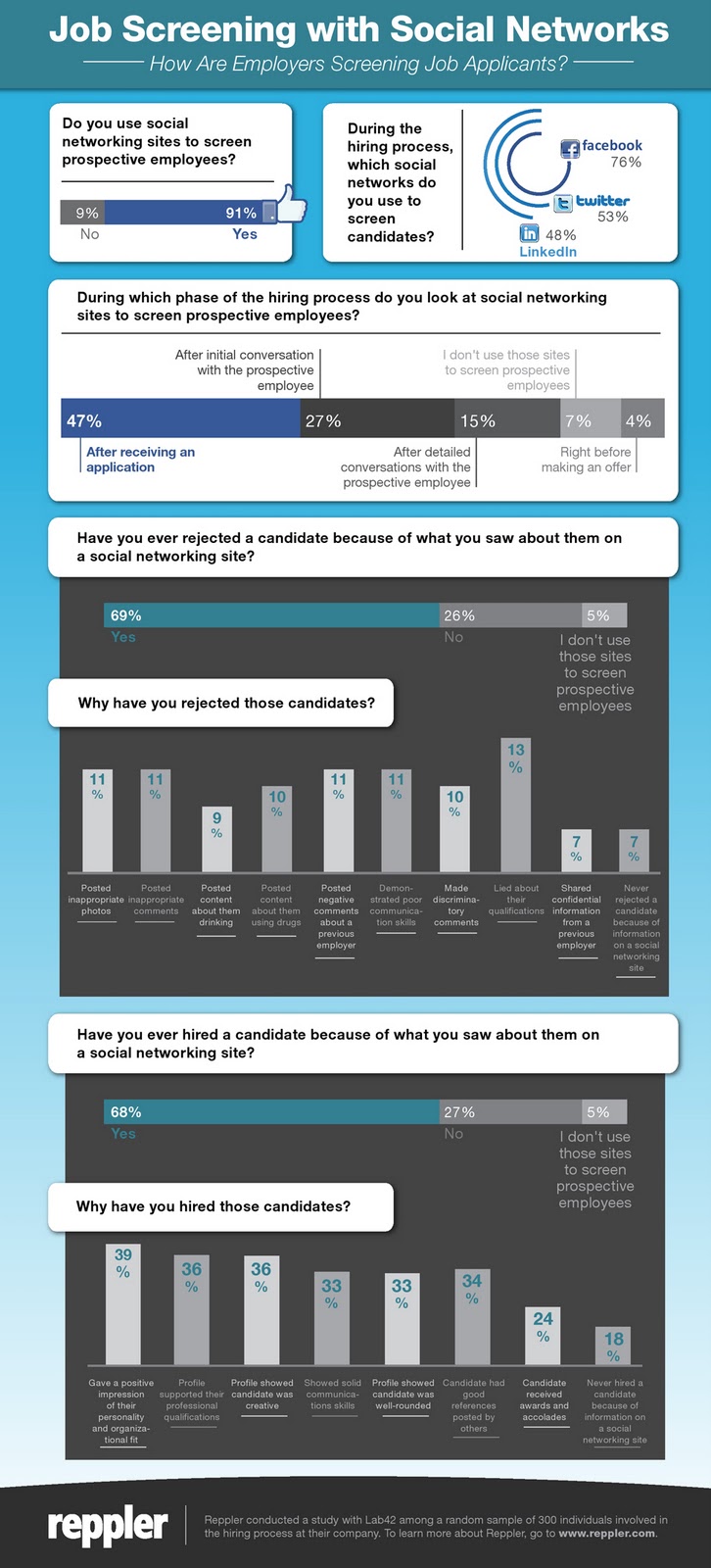
Do recruiters use Social Networks to screen candidates? Absolutely. As they should!
Those of us who use social media would do well to read and heed Mashable's fascinating information graphic.
Visit Mashable for a closer look.
Hat Tip: April
Subscribe to:
Posts (Atom)