Tuesday, June 30, 2015

Finger Length and Personality, Part 3: Q&A

I must admit, I have been smitten with curiosity about the so-called 2D:4D ratio. I find its implications for improved self-awareness and appreciation of diversity to be compelling. This is the third post on the subject, the previous ones having to do with the Higher Perspective article and then my attempt to more accurately measure the 2D:4D ratio


I also dedicated a whole edition of L.I.N.K.S. to the subject, and I published a related inquiry on facial symmetry--a feature that, like ring finger length, tends to increase in response to pre-natal androgen exposure. 


That is a lot of exploration and investigation already. But, being the curious sort, I feel one really good question usually inspires two or three dozen more. And so I have prepared for you a list of additional questions (and some preliminary answers). It's my hope that this Q&A monologue will engage readers and inspire something more like a dialog. If you share my interest in this topic and would like to advance the conversation, please feel free to chime in--via comments.

Here we go!
  • Does it matter if you measure the ratio on your left hand or your right hand? If the measurements are different, which one is more accurate? 
Higher Perspective said simply to look at the back of your left hand. Most scientific studies I have seen cited have used calipers to accurately measure the digit lengths on the palm side. The copy machine works well enough for practical purposes as any errors are proportional. Some studies specify the right hand for increased accuracy, though I have yet to see why that should be the case. I suspect it's because "most people" are right-hand dominant. I suggest either using the hand with the greatest variation, or, having measured both, averaging the two.
  • If your instincts are hardwired, how much choice do you really have in the heat of the moment? Are people with low 2D:4D ratios more likely to be aggressive drivers? 
Studies have shown a positive correlation between longer ring fingers and increased risky behavior. Obviously, behavior can be learned (or unlearned) through training, but it is interesting to note that a certain amount of aggressiveness is apparently innate. Studies have shown, for example, positive correlation between longer ring fingers and aggressive driving. 
  • Is there a correlation between finger length ratio and other measures of personality, such as the MBTI profile? Are certain ratios disproportionately represented among Es or Is, for example? 
Low 2D:4D ratios are correlated with increased confidence, risk preference, search persistence, and vigilance. However, these traits are not unique to introverts or extroverts, so there does not appear to be a strong positive correlation between finger length ratios and personality type indicators such as the Jungian Meyers-Briggs Type Indicator (MBTI). It's worth noting that behavior and preference are different. 
  • Is there a correlation between finger length ratio and a person's sex (male, female, or intersex), sexual orientation (i.e., gender identity, e.g., male, female, trans, queer), or sexual preference (asexual, heterosexual, bisexual, homosexual)?
The sex difference in digit ratios is unrelated to the Y-chromosome. Estrogen in utero does not produce larger ratios. The presence or absence of testosterone explains all the difference. 
  • What are the ranges of ratios that have been measured?
Bailey and Hurd (March 2005) has a sample of 134 people. The distribution of men's finger length ratios has a mean of 0.947 and a standard deviation of 0.029. For women, the statistics are 0.965 and 0.026. 
  • Are there any published studies correlating the effects of pre-natal androgens? For example, to what degree are finger length ratios and facial symmetry correlated?
There must be a study correlating finger length ratio and facial symmetry, but I have not found it yet. I did find a study that found a positive correlation between finger length ratio and penile length. Apparently, the researchers took measurements of male subjects while they were under general anesthesia 
  • To what extent should finger length ratio influence your choice of  a potential mate? Should the ratio matter more or less than, say, a zodiac sign? In other words, is the finger length ratio merely a persistent but meaningless bit of pop psychology, or is it a window into serious insight?
No, those jeans fit you perfectly! 

  • What, if anything, do these topics have in common? How are they related if at all? 
    • Numerology
    • Tarot
    • Astrology (signs of the zodiac)
    • Parapsychology (hypnosis, extra-sensory perception, telepathy, etc.)  
    • Phrenology (reading the bumps on a person's skull for insights into brain structure and function)
    • Chiromancy (reading the proportions of a persons hands and fingers for predictions of future health and well-being)
    • Finger Length Ratio
    • Positive Psychology
    • Myers-Briggs Type Indicator
    • Abnormal Psychology
You are looking at a list of 10 topics ranging from parapsychology to pop psychology to main stream psychology. They are listed in order of my estimation of their relative seriousness, beginning with topics that require the most skepticism and progressing to the topics that are relatively more sound. I conclude the Q&A with this point to show that I think the finger length ratio is more useful and more reliable than most of the other topics, but still less accepted in academic circles.

Send or post your responses to the questions posed, your additional questions, more links as you find them, and your own answers as you think of them.

The Shape Of Your Nails Reveals A Lot About You

Image of Fingernails: American Overlook


Now we think that different fingernail shapes correlate with personality traits? I have no idea how this works. I merely pass along the interesting information with the added value that it seems to be accurate as far as I can tell, n = 1.

Does it work for you? Any ideas how it works? Is this purely genetic, or could it be related to pre-natal androgens?

For the record, my nails most certainly match the picture labeled with number "1" in the image and called "Vertically Long" in the article. Here is the associated description:

"Your wonderful and weird imagination compliments your romantic and mild temperament. As a creative individual, you meticulously watch the details and can get overwhelmed with your surrounding environment. You spot details others miss and people love being around you as you can get along with almost everyone."

I can work with that!

What will you do with your extra second?

June 30, 2015 has an extra second. How will you put that time to use?

For the 2d time in the history of PhilosFX, the international scientific community have decided to add a "leap second" to the last day in June.

A leap second is a one-second adjustment that is occasionally applied to Coordinated Universal Time (UTC) in order to keep its time of day close to the mean solar time. Since this system of correction was implemented in 1972, 26 leap seconds have been inserted, the most recent on 30 June 2015 at 23:59:60 UTC.

What to do with the extra time? Gawker.com's free ideas for what to do with today's extra second are nearly perfect. I love how people add fun comments and suggestions.

As the clock struck an extra long midnight in London, the FIFA Women's World Cup semi-final match between USA and Germany was just getting underway in Montreal (at 7 p.m. Eastern Time).
I know how I'm gonna use today's leap second! I want to watch O'Hara's goal in the 84th minute of the match! Put that video on Vine!

The gifted free time is designed to compensate for the drag caused as our planet wobbles a bit more than usual now and then. Of course all of this is beyond my ability to discern, To me, it is amazing that we have atomic clocks that can detect this difference, and computers that demand the accuracy.

The last time we had a leap second was 2012, and I put up a little blog post to celebrate in good humor. As of today, that post has garnered 10,758 views, my single most-viewed post. It also attracted 893 comments. Will this post rival that one for interaction? Something about astrophysics just gets people excited...


Friday, June 5, 2015

Ch'an Master Seng-Ts'an

Ch'an Master Seng-Ts'an

Earlier this morning I was absorbing my daily dose of The Book of Awakening by Mark Nepo. The epigraph for today's reading seemed especially relevant in light of the media hubbub around Caitlyn Jenner. 


"There is no need 
to seek the truth--
just put a stop 
to your opinions!" 
--Seng-Ts'an 

Curiosity thus piqued, I found and share herewith the following page about Ch'an Master Seng-Ts'an.

Thursday, June 4, 2015

War and Peace: For how much of your life has the U.S. been at war?

This Washington Post blog post by Philip Bump caught my attention, mainly for the eye-catching infographic copied below. To see the image more clearly, please visit the Post blog.

Image Credit: This corrected graphic appears with the cited WaPo article


Most people graduating from college this year were born in 1992 or 1993. Here is a sobering dose of reality for young people preparing to embark on new careers post-graduation:

If you are an American born in the early 1990s, your country has been at war for approximately 64% of your lifespan.

The motive of the article and accompanying infographic was to provide information to correct the statistic offered by a recent commencement speaker, Martha Raddatz, who underestimated the actual number at 50%.

The idea of the graphic is well-explained in the blog post. The graphic is effective for its purpose of showing a person of a given birth year approximately how many years the US has been at war over the course of their lifespan.

The graphic has a couple of other uses as well.

  • One can look at the chart and quickly see that about 60 million young Americans have lived their whole lives in a country at war. 
  • I was born in 1960. There are approximately 4.5 million Americans in my cohort. The United States has been at war for approximately 44.6% of our lives. 
  • I spent 33 years in uniform, and 28 as a commissioned officer on active duty. During the course of my active duty career, the Nation was at war 81% of the time. 


One could quibble, I suppose, with what gets counted as a war and what does not, and how the duration of each war is tabulated, but I believe Mr Bump explains these things satisfactorily.  I have no quarrel with the idea of rounding conflicts up to the nearest whole year, because even though the first Gulf War lasted only 100 hours, the preparation and recovery easily filled up a year. And I have no real issue with Kosovo not counting as combat, even though when I was there, and we wore helmets and flak jackets and carried weapons and ammo for a reason.

But I do have a serious beef with the infographic.

This chart implies that if the Nation is at war, the population experiences the effects of war equally. The motivating idea of the chart was to correct a commencement speaker on a statistic, and I agree that 64% is more accurate than 50%. However, no 22-year old graduating today has picked up a rifle in defense of Country. Unless they come from a military family where a parent or older sibling has deployed to Iraq or Afghanistan, they have not participated in the wars that have been fought during their lifetimes. The people of a cohort do not experience the effects of war equally.

So what is missing from the chart? One percent of the citizens have done 100% of the fighting.That is what's missing. Show the numbers of people in each annual cohort who have spent time in uniform, and I'll be happier with the chart.

So I sent the article's author the following email. We'll see what happens.

INFOGRAPHIC NEEDS A TWEAK
Dear Mr. Bump: 
Bottom line up front: The graphic accompanying your May 25th article, “Here’s how much of your life the United States has been at war,” is good but could be easily improved with dramatic effect. Consider showing the numbers of veterans in each cohort. It’s fine to tell today’s graduates that they have actually been living in a country at war 64% of their lives rather than only 50%, but the broader point of your post (and Martha Raddatz’s original intent) was to illustrate that 1% of the population has done 100% of the fighting. Today’s young people do not have much connection to war unless a parent or older sibling has deployed to Iraq or Afghanistan—and the probability of that is a very small.
You can get the Census Bureau data on Veterans in each cohort. I am just asking you to include the numbers of Veterans in the mix. We have 25 million living Veterans. Spread them out across the population in each year group so your readers can see what 1% looks like. I think you will see a relatively high proportion of the population who were Veterans from the WWII era, and that also helps make you point.
I noticed you have already corrected the chart once, to fix the scale on the left side. Why not really drive your point home? Put Veterans on the chart and update the article. Will you consider it?
Thank you for reading and keep up the great work!
Sincerely,


During my 28-year military career, which spanned from my commissioning in May of 1984 to my retirement in May 2012, the military forces of our great Nation were called upon many times. There were hundreds of operations short of war that did not make the cut for this infographic. But again, that is not the issue. The issue is that every time the Nation called, the volunteers who were already in uniform anyway were always the ones who answered. The gap between the average citizen and the professional soldier is too large for a healthy society.


This graphic appeared with the original WaPo article. The scale on the left side has been since corrected.


Saturday, May 30, 2015

Trunkworthy's First 40: Elvis Costello's Best, Least Remembered Songs


Beginning 40 weeks ago, on Elvis Costello's 60th birthday, the boys over at Trunkworthy began a project I have been following very closely. Each week, they post a forgotten gem from Elvis Costello's vast catalog. And each week, I have been saving a link to the weekly Trunkworthy article


Trunkworthy cofounders Gary Stewart and David Gorman select each song, write a highly entertaining and informative description, and post a video. They have also created a Spotify playlist called Elvis Costello Songs of the Week, which currently has a mere 242 followers. I am writing today to call additional attention to Trunkworthy. and in particular to this fantastic Elvis Costello project. 


Without further ado, here is a table of the first 20 songs in the Trunkworthy collection of Elvis Costello Songs of the Week.   


Need more convincing? OK, here is a table of the second 20 songs--and there's plenty more where these came from!


Seriously great stuff! If you are already a long-time Elvis Costello fan like me, then you need no convincing. But if you are new to Elvis Costello, Trunkworthy is building a great selection of the prolific, genre-busting artist's best least remembered songs.


Expressions: A Look at Facial Symmetry and Its Implications on the Perception of Beauty


People actually prefer slightly asymmetrical facial features


"Beauty is truth, truth beauty,—that is all 
Ye know on earth, and all ye need to know."

John Keats (1795–1821) Ode on a Grecian Urn


While symmetrical faces are perceived to be attractive,
completely symmetric faces are disconcerting and are not perceived as normal.


Recently, while investigating the finger length ratio, I learned that the length of a person's ring fingers is determined by the amount of testosterone present in the womb during pre-natal development. The more testosterone, the longer the ring finger. This is true for males as well as females, but the correlated behavior traits are more pronounced in men. Other characteristics that are influenced by androgens in utero include a person's facial symmetry. The more testosterone in the womb, the more symmetry in adult facial features. 

Right after calculating my 2D:4D ratio (and trying to interpret it), I set out to investigate the degree of symmetry in the face of my closest available subject, moi. For readers who share my curiosity, here is a quick tutorial on how to select and manipulate a photo to investigate facial symmetry. I'll conclude the post with some thoughts on why this matters.


Original

Select a photo that is evenly lit and as nearly straight on as possible. Stoic expressions are fine, but I think it makes sense to find an expression that most people would recognize as natural.


Construct a grid and rotate the picture so that it is as nearly vertical as possible. You may need to focus on getting the eyes on the same plane, particularly if there is no distinct vertical axis. 


Modified original, aligned and cropped

Crop the photo to provide a small border around the area of interest (face). 


Now you are ready to make the vertical cut that divides the face into two halves. Try to slice down the axis of symmetry, splitting the forehead, nose, teeth, and chin as evenly as possible in one straight vertical line. You may have to minimize errors by splitting differences. That is, if the nose is off-center a little to the right and the teeth are off center a little to the left, the best vertical line would minimize the errors by splitting the difference between the nose center and the teeth center.


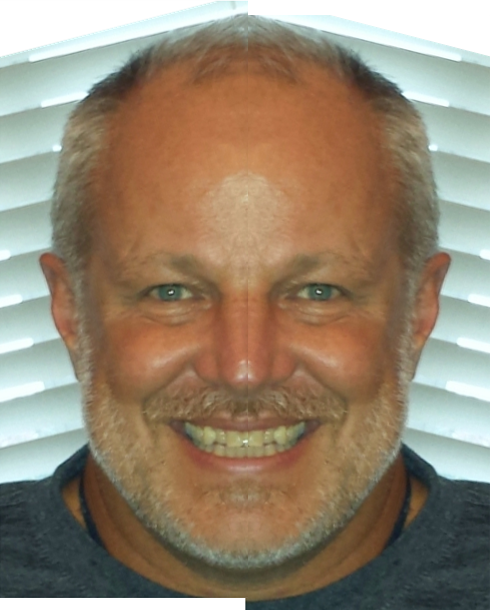
Next you are going to flip the images by rotating them around the vertical axis you have just described. As you create the four halves, give them distinct names like Right (i.e., the subject's right) and Flipped Right (i.e., the result of rotating the right image vertically 180 degrees). You'll also have Left and Flipped Left halves.

Right Symmetry

Once you create and identify the four halves, you can start mixing them up to create four different combinations. Two right halves, the right and flipped right, placed together side-by-side form the Right Symmetry view (shown above).


Left Symmetry
The left and flipped left halves create the Left Symmetry view (shown above).


Mirror
Put the two flipped sides together to create the Mirror view (shown above). At this point, you are ready to construct the complete set of four views.


Once you have the four essential views, you will need some software for consistent, reproducible evaluation of the degree of symmetry in each of them. Obviously, the constructed right and left symmetry views should have a very high degree of symmetry, and the original and mirror views should have similar, if lesser degrees of symmetry.  

Symmeter (http://www.symmeter.com/index.html) is a web-based system that provides a simple way to measure the symmetry of any person, place or thing using a digital image. Symmeter requires a small file, 100K or less, in JPEG format. If you want to convert files without downloading software, I had good luck with Zamzar (http://www.zamzar.com/). They have a fast and easy tool for converting your large and rich .png files to simpler .jpg files. As for Symmeter, it uses some older technology that does not mesh well with Google or Firefox, but I was able to get it to work with Explorer. 

Upload your first file to Symmeter and choose bi-lateral symmetry. Don't choose radial symmetry unless you are evaluating a wheel or a pizza. Define your area of interest with a rectangle or an ellipse. I found that I got better results, i.e., a higher symmeter value, when I used an ellipse instead if a rectangle. The square may be better for folks with wider faces. The system returns a number called the Symmeter Value, which is the percentage of symmetry in the area defined. The Symmeter value for most faces will be in the mid to high 90's, which is why the precision of the decimal places is important.  I rounded the fourth decimal to create the table below.


Notice that the Original and the Mirror are fairly close in value, as expected, but the Mirror is higher. I am not sure why they would not be exactly the same. Perhaps the photo was not taken dead-on, or perhaps the slightly uneven lighting casts some shadows that throw the results off. Notice that both Right and Left Symmetry views are very close to 100% symmetrical, as expected, with slight improvements using the ellipse.

Notice, too, that I added the results from a stock photo of George Clooney to the results table. I concede that George is an exceptionally handsome man. Notice that the image of George Clooney has a Symmeter Value of 94.792, noticeably less than the primary subject. The statement is not that I have a more symmetrical face than George. Even if that is true, my point was more to the fact that perceptions of beauty are only partially based on symmetry. Collecting the symmeter value is an exercise in the pursuit of truth. The truth has a beauty all its own. There is no positive correlation between Symmeter value and aesthetic appeal (or if there is, that is not my point). Case in point: the image labeled Left Symmetry is more appealing than the one labeled Right Symmetry, even though they have similar and very high bi-lateral symmetry.    

There are plenty of web sites that discuss the issue of facial symmetry and beauty. The primary subjects seem to be "Beautiful People" celebrities like Tom Cruise, Angelina Jolie, Brad Pitt, and the aforementioned George Clooney. Although symmetry is theoretically desirable, plenty of folks with asymmetric faces have adorned the cover of People magazine. 


Gorgeous George, charter member of Jimmy Kimmel's
Handsome Men's Club

Symmetry is not necessary for aesthetic appeal. Few things in nature are symmetrical, and as stated at the outset of this post, completely symmetric faces are disconcerting and are not perceived as normal. Since I know that my Left Symmetry is more visually appealing than my Right Symmetry, I will use that to my advantage. But I will also be suspicious of superficial beauty, now that I understand how easily my eyes can be fooled.  

This brings us to the concluding thoughts about my motives for this investigation and related inquiries into physical and behavioral characteristics that, to some extent, are determined genetically. I do not care about finger length because a certain 2D:4D ratio is "desirable." Nor am I interested in facial symmetry because a certain Symmeter Value is "superior." I do not think one MBTI profile is "better" than the others.  But I do care about understanding and appreciating the truth inside of biological diversity.  There is real beauty in that pure truth.

Next steps in the inquiry would probably involve relating the degree of symmetry to the finger length ratio an a large number of subjects. The hypothesis would be that if a developing fetus is exposed to a certain level of androgens in utero, and if the effects of  this exposure are increased facial symmetry and longer ring fingers (among other effects) then these effects should be correlated. Perhaps someone has already started this investigation.

Is aesthetic appeal the same thing as beauty? If we believe Keats, aesthetic appeal can be a mirage, but the truth is beautiful.  

"Beauty is truth, truth beauty,—that is all 
Ye know on earth, and all ye need to know."