Showing posts with label Twelve Days of Christmas. Show all posts

Sunday, January 11, 2015

The First Day of Christmas? Part IV

Welcome to Part IV, the final installment in the series about the First Day of Christmas.


What, Christmas on January 11th, you say? I deliberately waited until the third Sunday after Christmas to post this final installment inspired by the song, Twelve Days of Christmas. This series of posts has been my stab at a definitive answer to these four perennial questions:


  • What is the first day of Christmas? December 26
  • What do we mean by the Christmas Season? Let's call it Dec 6 through January 6
  • Thinking about the song and all the gifts on each of those days, how many presents arrive in all? A whopping 364! 
  • And speaking of gifts, is there any significance behind the seemingly random gift choices? 


  • We tackled the third question in Part III of the series. Missed it? Get caught up HERE.

    And now, 
    wrapping things up 
    with Part IV:


    You know the famous song and have sung (or heard it sung) it many times at Christmas.

    On the twelfth day of Christmas
    my true love gave to me:
    Twelve Drummers Drumming
    Eleven Pipers Piping
    Ten Lords a-Leaping
    Nine Ladies Dancing
    Eight Maids a-Milking
    Seven Swans a-Swimming
    Six Geese a-Laying
    Five Golden Rings
    Four Calling Birds
    Three French Hens
    Two Turtle Doves and
    a Partridge in a Pear Tree

    Read more: HERE


    Where did all these wacky gift ideas come from? I mean, if I wanted to demonstrate my true love in the same way, my lady would need a barn for all the cows, swans, geese, birds, hens, doves, and partridges. (Some sources state that the five rings are not jewelry but ring-necked birds, such as the Ring-necked Pheasant. Great--even more birds!) Not to mention a very large house and food budget for all the drummers, pipers, lords, ladies, and maids. Why not sweaters, pajamas, and music CDs?

    Perhaps you have heard the popular explanation that the gifts are actually part of a shadow catechism--that parents used the song to teach their children about the Bible during a time of religious persecution. A common version of that story looks like this:
    The songs gifts are hidden meanings to the teachings of the faith. The "true love" mentioned in the song doesn't refer to an earthly suitor, it refers to God Himself. The "me" who receives the presents refers to every baptized person.
    The partridge in a pear tree is Jesus Christ, the Son of God.
    2 Turtle Doves = The Old and New Testaments
    3 French Hens = Faith, Hope and Charity, the Theological Virtues
    4 Calling Birds = the Four Gospels and/or the Four Evangelists
    5 Golden Rings = The first Five Books of the Old Testament, the "Pentateuch", which gives the history of man's fall from grace.
    6 Geese A-laying = the six days of creation
    7 Swans A-swimming = the seven gifts of the Holy Spirit, the seven sacraments
    8 Maids A-milking = the eight beatitudes
    9 Ladies Dancing = the nine Fruits of the Holy Spirit
    10 Lords A-leaping = the ten commandments
    11 Pipers Piping = the eleven faithful apostles
    12 Drummers Drumming = the twelve points of doctrine in the Apostle's Creed
    We do not know the author of the interpretation, nor do we know if the story comes before the lyric or after. Read more HERE
    There may be a bit of truth to the idea that this song is a shadow catechism. Jews, Masons, slaves and spies have all devised ways of sending hidden messages in plain sight of persecutors. Christians have not been persecuted in Europe since the end of the Roman Empire. There were no practical reasons for Christians to use a shadow catechism after the Edict of Milan in 313. That said, the idea of linking each of the twelve gifts to the Bible has a precedent.

    The song as we know it today appeared in its earliest known printed version in the 1780 children's book Mirth Without Mischief. The song is apparently much older than this printed version, but we do not currently know how much older. What we do know is that the structure of the song is similar to one called A New Dial.

    Again, from Snopes
    It is possible that "The Twelve Days of Christmas" has been confused with (or is a transformation of) a song called "A New Dial" (also known as "In Those Twelve Days"), which dates to at least 1625 and assigns religious meanings to each of the twelve days of Christmas (but not for the purposes of teaching a catechism).
    Snopes denies that the lyrics to A New Dial were intended to teach a catechism, but that is a matter of opinion, not fact. I think it's entirely possible that A New Dial was indeed used to teach the Bible. Furthermore, it is remotely possible that the structure of twelve things recited in a question-and-answer format goes all the way back to a time when Christians were persecuted. We simply don't know.

    Here is a snippet of A New Dial. It sounds like a catechism to me.

      What are they that are but one?
      We have one God alone
      In heaven above sits on His throne.

      What are they which are but two?
      Two testaments, the old and new,
      We do acknowledge to be true.

      What are they which are but three?
      Three persons in the Trinity
      Which make one God in unity.
    ... and so on, through the number twelve. Read more HERE or in the Table below. 


    My side-by-side comparison of "The Twelve Days of Christmas" with its apparent predecessor, "A New Dial" reveals some similarities and some differences. Note that half (5 of 12) of the items are the same (=) and the other half (7 of 12) are different (X). 

    "A New Dial" (also known as "In Those Twelve Days"), which dates to at least 1625 and assigns religious meanings to each of the twelve days of Christmas."The Twelve Days of Christmas" was presented in its earliest known printed version in the 1780 children's book, Mirth Without Mischief. It seems similar to the much older verse.
    What are they that are but one? The partridge in a pear tree is Jesus Christ, the Son of God. 
    We have one God alone x
    In heaven above sits on His throne. 
    What are they which are but two? 2 Turtle Doves = The Old and New Testaments 
    Two testaments, the old and new, =
    We do acknowledge to be true. 
    What are they which are but three? 3 French Hens = Faith, Hope and Charity, the Theological Virtues 
    Three persons in the Trinity x
    Which make one God in unity. 
    What are they which are but four 4 Calling Birds = the Four Gospels and/or the Four Evangelists 
    Four sweet Evangelists there are, =
    Christ's birth, life, death which do declare. 
    What are they which are but five? 5 Golden Rings = The first Five Books of the Old Testament, the "Pentateuch", which gives the history of man's fall from grace. 
    Five senses, like five kings, maintain x
    In every man a several reign. 
    What are they which are but six? 6 Geese A-laying = the six days of creation 
    Six days to labor is not wrong, =
    For God himself did work so long.
    What are they which are but seven? 7 Swans A-swimming = the seven gifts of the Holy Spirit, the seven sacraments 
    Seven liberal arts hath God sent down x
    With divine skill man's soul to crown. 
    What are they which are but eight? 8 Maids A-milking = the eight beatitudes 
    Eight Beatitudes are there given =
    Use them right and go to heaven. 
    What are they which are but nine? 9 Ladies Dancing = the nine Fruits of the Holy Spirit 
    Nine Muses, like the heaven's nine spheres, x
    With sacred tunes entice our ears. 
    What are they which are but ten? 10 Lords A-leaping = the ten commandments 
    Ten statutes God to Moses gave =
    Which, kept or broke, do spill or save. 
    What are they which are but eleven? 11 Pipers Piping = the eleven faithful apostles 
    Eleven thousand virgins did partake x
    And suffered death for Jesus' sake. 
    What are they which are but twelve? 12 Drummers Drumming = the twelve points of doctrine in the Apostle's Creed
    Twelve are attending on God's son; x
    Twelve make our creed. The Dial's done.


    After looking at a side-by-side comparison of "A New Dial" and "The Twelve Days of Christmas," I see some similarities but still have a lot of questions. Let's just say that Christians at some point in history for whatever motive simply wanted to have a verse to talk or sing about the Bible. And let's just say that the structure of call and response with twelve items was popular enough to be passed along orally for years and years. We still don't know:

    • When was the descriptive interpretation of The Twelve Days of Christmas written (i.e., 10 Lords A-leaping = the ten commandments)? Was the description really a contemporary sub-text to the lyric? Or was it written much later? If later, as I suspect, then idea that the song was a shadow catechism collapses.
    • If A New Dial is truly the predecessor of The Twelve Days of Christmas, why do the "stories" differ in detail over 50% of the time? 
    • Even if we accept the premise that a shadow catechism dating from before the Edict of Milan morphed from A New Dial to The Twelve Days of Christmas, and further accept that 10 Lords A-leaping = the ten commandments, we still have no explanation--no clue whatsoever--for Lords A-leaping. Why Lords A-leaping? Why not nice sweaters? We simply do not know.  
    Let's chalk it up to creative license!

    Speaking of gift ideas that seem strange to us today, did you ever wonder why the magi gave Jesus gold, frankincense and myrrh? These valuable items were standard gifts to honor a king or deity in the ancient world: gold as a precious metal, frankincense as perfume or incense, and myrrh as anointing oil. Read more HERE

    This brings us to the end of our four-part exploration into the First Day of Christmas. I hope you have enjoyed this series. 

    Recapping:
    • December 26 is the First Day of Christmas. The Twelve Days of Christmas conclude on Epiphany.  
    • The "Official" Christmas Season for shopping and decorating purposes begins on Saint Nicholas Day and ends on Epiphany. I propose the term Christmastide, be modified to include the period of Advent, Christmas Day, and the Liturgical Christmas Season 
    • The total number of gifts given by the singer's true love is 364--enough gifts for one per day from the first day of Christmas on December 26th to the following Christmas Eve.  
    • The gifts have no hidden meaning relating to the catechism and rumors to that effect are unsubstantiated. The gifts seem random but they are no more bizarre than the original gifts of gold, frankincense and myrrh. 
    I hope that you will remember the main ideas from these four posts when Christmas comes around again. When will you start thinking about Christmas? When will those thought be put into action? How will you build anticipation for the day of Jesus' birth? How will you celebrate the occasion? How will you taper off from that high point and carry the lessons forward, sharing them with others?

    Tuesday, January 6, 2015

    The First Day of Christmas? Part III

    The First Day of Christmas? Part III of IV


    Welcome to Part III of the First Day of Christmas, my stab at a definitive answer to these four perennial questions:


  • What is the first day of Christmas? In other words, on what day did the original singer's first present of a partridge in a pear tree arrive? (Answered in Part I.) 
  • What do we mean by the Christmas Season? I see that phrase interpreted so many ways. Does it have any definitive, commonly understood meaning? (Answered in Part II.) 
  • Thinking about the song and all the gifts on each of those days, how many presents arrive in all? Think about it for a second. Five golden rings on days 5 through 12 amounts to 40 rings!  
  • And speaking of gifts, is there any significance behind the seemingly random gift choices? This will be the subject of Part IV.


  • We tackled the second question in Part II of the series. Missed it? Get caught up HERE.


    And now, 
    tallying up the gifts 
    with Part III:


    If you read the lyric literally, the giver gives his true love lots of presents. On the first day, a partridge in a pear tree. On the second day. two turtle doves AND a partridge in a pear tree. So that is three things on day two and the cumulative total is two turtle doves and TWO partridges in pear trees.

    Now. let's review the shipment of gifts that arrives on the twelfth and final day:

    On the twelfth day of Christmas
    my true love gave to me:
    Twelve Drummers Drumming
    Eleven Pipers Piping
    Ten Lords a-Leaping
    Nine Ladies Dancing
    Eight Maids a-Milking
    Seven Swans a-Swimming
    Six Geese a-Laying
    Five Golden Rings
    Four Calling Birds
    Three French Hens
    Two Turtle Doves and
    a Partridge in a Pear Tree

    Read more: HERE


    The total on day 12 is a whopping 12+11+10+9+8+7+6+5+4+3+2+1=78 things! Is that surprising? Did you ever picture all that commotion when you sang the song? And where are all the "gifts" from days one through eleven? This is a strange love, indeed, is it not?

    I mean, if I wanted to demonstrate my true love in the same way, my lady would need a barn for all the cows, swans, geese, birds, hens, doves, and partridges! Not to mention a very large house and food budget for all the drummers, pipers, lords, ladies, and maids.... 

    If you do the math, as I have done, you will discover something else quite remarkable. Have a gander at the table below. 


    The total number of gifts given over twelve days is enough for one gift, be it a calling bird or a maid a-miking, per day for 364 days. Said another way, that's a gift per day from December 26th, the first day of Christmas, to December 24th of the following year--and the only day when there is not a gift is Christmas Day itself, the day God became flesh.

                                          And now you know...

    the rest of the story! 


    The First Day of Christmas? Part II

    Welcome to Part II of the First Day of Christmas, definitive answers to these four perennial questions inspired by the classic song, "The Twelve Days of Christmas:"


  • What is the first day of Christmas? In other words, on what day did the original singer's first present of a partridge in a pear tree arrive? Answer: December 26th!
  • What do we mean by the Christmas Season? I see that phrase interpreted so many ways. Does it have any definitive, commonly understood meaning? Or is it just a broad, sweepingly indistinct term? Is there value in defining the season, or should we let it be open to interpretation? 
  • Thinking about the song and all the gifts on each of those days, how many presents arrive in all? Think about it for a second. Five golden rings on days 5 through 12 amounts to 40 rings!  Coming soon in Part III
  • And speaking of gifts, is there any significance behind the seemingly random gift choices?  Coming soon in Part IV


  • We tackled the first question in Part I of the series. Missed it? Get caught up HERE.


    And now, 
    Onward and Upward 
    with Part II

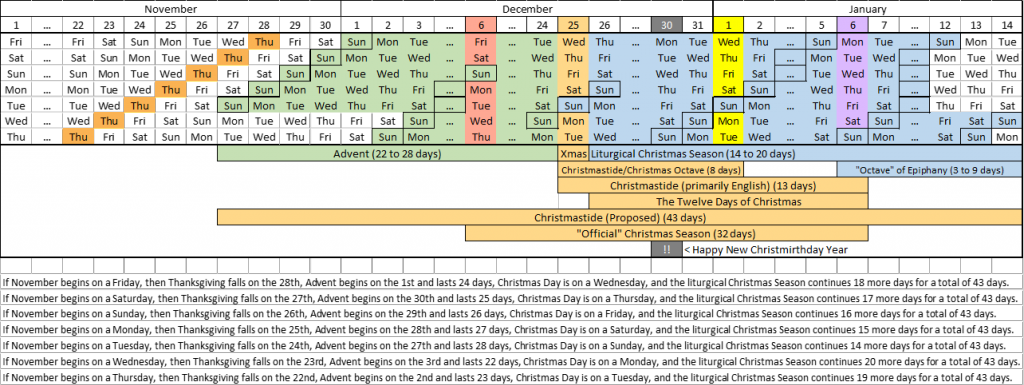
    What, exactly, do we mean by the Christmas Season? I know the answer (smile), but before I reveal it, let's discuss why there is even a question. Opinions vary, as they say. To understand the over-arching Christmas Season question a bit more deeply, let's list and define some distinct periods of time that take place within the season:
    • Advent: Interpreted on the liturgical calendar as 4 Sundays and weekdays before Christmas Eve. Each of the four weeks are often represented by a colored candle representing Advent themes of Hope, Love, Joy, and Peace, respectively. These colored candles surround a pure white Christ candle. Messages of Hope, Love, Joy, and Peace are discussed and celebrated in successive Sundays of Advent, and the Christ candle is lit on Christmas Eve. 
      • In 2014, the Advent Season was November 30 through December 24, or 25 days, inclusive. Advent can range from 22 to 28 days in length. 
      • However, if you buy an Advent Calendar, you'll see it usually includes the first 24 days of December, counting down the days to Christmas and, with treats of chocolate, building anticipation for the birth of the Savior. 
      • Of course, there is the coincidental fact that 24 is also the number of beers in a case of beer. and 24 different winter beers would make a wonderful adult Advent calendar!  
      • But, I digress...
    • Christmas Season
      • According to the liturgical calendar, Christmas Season begins after Advent, i.e., at midnight on Christmas Day, and continues for 3 Sundays and weekdays after. So for 2014, the Christmas Season is Thursday December 25 through Sunday January 11, 2015.
      • Some others say the Christmas Season begins with Black Friday sales on the day after Thanksgiving and ends when the last of the wrapping paper is wadded up in the trash, 
      • This year, for the first time, I saw Christmas decorations up in stores before Hallowe'en. Personally, I find that the crass commercialization of Christmas reflects poorly on our National values, but to each his own. Ayn Rand would say that the commercialization of Christmas reflects perfectly on our crass National values. 
      • But again, I digress.... Ayn Rand is the subject of a different blog post.
      • And can we please recycle the wrapping paper?
    • Christmas Octave: 8 days from December 25 to January 1, inclusive. I do not hear this one mentioned much except among musicians. (That was a joke.) Seriously, this is an archaic term, except without it we would never understand the next term... 
    • Octave of Epiphany: The period of time from Epiphany to the 3rd Sunday after Christmas, inclusive, is a period of about 8 (actually anywhere from 3 to 9) days depending on which day of the week Christmas lands on. The only reason the liturgical Christmas season runs past Epiphany is so that Advent plus Christmas Day plus Christmas Season gets us to 40-ish days (actually 43 days, regardless of which day of the week Christmas lands on. Of course 40-ish days is parallel to the 40-ish days of Lent and the 40 days Jesus spent in the wilderness.
    • Christmastide. Adding to confusion about the meaning and duration of the Christmas Season, we have a new term with even more variation around it. The dictionary compounds confusion with two different definitions of Christmastide
      • the festival season from Christmas to after New Year's Day. Note that this is the same period of time that has already been called the Christmas Octave.
      • the 14-day period from Christmas Eve to Epiphany, especially in England.
      • don't forget the so-called Twelve Days of Christmas which ends on Epiphany and so must begin on December 26
    • My birthday falls between Christmas and New Years Day. Growing up, I always felt that my birthday got lost in the seasonal sauce, There is a season of quiet reflection in the week between holidays. I call it Happy New Christmirthday Year.    

    To see this image full size, click HERE


    All of these different terms have meaning and value, even if they overlap or cause confusion. Here is the bottom line for me. Tradition. I celebrate Thanksgiving. Then a break in time happens and maybe a subtle hint of the Advent is detected. I finally get into the cookie-baking, package wrapping, tinsel-hanging, card-writing Christmas spirit with Saint Nick on December 6th. The anticipation builds until midnight between Christmas Eve and Christmas Day, or whenever the Christ Candle is lit, or whenever the baby Jesus is placed in the manger of the Nativity scene at home, or whenever the youngest person in the household places the Angel atop the Christmas tree. Christmas Day is quiet and holy with presents for everyone and plenty to eat. Then, the Twelve Days of Christmas begin on the 26th, but unlike the song we do not continue with gifts. Instead, the season of Christmas is extended past birthday and New Years to Epiphany with reflection about the year passed and plans for the year ahead. The fact that the season extends past Epiphany is usually lost on me. In Casa del Foam, my humble abode, the Christmas Season is the 32-day period from December 6th through January 6th, inclusive. 

    By tradition in my household, it is bad form to decorate for Christmas before December 6 or after January 6. I am fine with Advent calendars and of course Advent-themed worship services before December 6th. In fact, I am pretty much fine with the idea of celebrating Christmas and Christian ideals year-round. It's just that Christmas music and some of the decorations and list-making and shopping should begin no earlier than December 6th. This gives space around Thanksgiving, acknowledges the original "St Nick," and includes the celebration of Epiphany which is when the wise men following a celestial compass finally found the Christ child and offered Him gifts, according to the Gospel of Matthew (2:11).

    If I send or receive a Christmas card a few days after Christmas, I don't think it's "late." But a Christmas card before Dec 6 seems in poor form, even if Advent has already begun. The only Christmas cards I got before Dec 6 this year were from businesses and universities hoping to catch me in a giving mood. The timing caused the opposite reaction! And a card sent or received after Jan 6 reflects poorly on the management skills of the sender. For these reasons, I believe the world would be a better place if everyone Christmas year-round, but only decorated between Dec 6 and Jan 6.

    Recapping Parts I & II:
    • December 26 is the First Day of Christmas. The Twelve Days of Christmas conclude on Epiphany 
    • The "Official" Christmas Season begins on Saint Nicholas Day and ends on Epiphany. This 32-day period of time exists inside the 43-day liturgical events of Advent, Christmas Day, and the Christmas Season. But only a Cretin would send a Christmas Card before Dec 6 or after Jan 6! 
    Feel free to comment or share how your traditions are different! 


    Saturday, January 3, 2015

    The First Day of Christmas?

    We all know the song. Most of us have sung it many times and heard it sung at Christmas many times more. 


    On the first day of Christmas
    my true love gave to me:
    a Partridge in a Pear Tree


    But, have you ever really thought about the implications of this classic Christmas song? In the spirit of joy and in the quest for understanding, let us consider the following questions:
    • What is the first day of Christmas? In other words, on what day did the original singer's first present of a partridge in a pear tree arrive? Twelve days before Christmas? Beginning on Christmas Day (but then ending before Epiphany)? Beginning on the first day after Christmas and culminating on Epiphany, the day the magi found Jesus? 
    • What do we mean by the Christmas Season? I see that phrase interpreted so many ways. Does it have any definitive, commonly understood meaning? Or is it just a broad, sweepingly indistinct term? Is there value in defining the season, or should we let it be open to interpretation? 
    • Thinking about the song and all the gifts on each of those days, how many presents arrive in all? Think about it for a second. Five golden rings on days 5 through 12 amounts to 40 rings!  
    • And speaking of gifts, is there any significance behind the seemingly random gift choices? I mean, if I wanted to demonstrate my true love in the same way, my lady would need a barn for all the cows, swans, geese, birds, hens, doves, and partridges. Not to mention a very large house and food budget for all the drummers, pipers, lords, ladies, and maids. Why not sweaters, pajamas, and music CDs? Oh, wait, the song was written before CDs, or cassettes, or albums, or...
    The aim of this post is to provide some rational answers to these questions. That and to stretch the Christmas season out to its full extent. I want definitive answers, if possible, or at least answers that make sense to me. Inquiring minds want to know--and if knowing is not possible, pragmatic inquiring minds will take an answer that makes sense until a better one comes along.

    Here we go!

    December 26th, not the 14th and not the 25th, is the First Day of Christmas. If you are going to celebrate the Twelve Days of Christmas with, say, one new winter beer for twelve days in a row or a series of gifts for your true love, and if you want to follow the tradition, start on December 26th. How do I know this? Follow this logic trail: Advent culminates on Christmas Eve (more on that later). Advent is a time for preparation, not celebration. Christmas Day, when Jesus was born, is a holy day--a day of reverence and gratitude. Traditionally, the gift-giving and celebration commenced on the 26th with the first of twelve successive Days of Christmas. This party culminates on January 6th with the Feast of Epiphany. If you start the Twelve Days on the 25th, the Twelfth Night falls on January 5th. But January 6th must be included in the period of celebration, because that is the day that the magi found Jesus and gave him gifts. That the Twelve Days of Christmas is interpreted differently by many is due in part to the fact that so many time segments are contain in what we call the "Christmas Season." Which brings us to question number two.

    Hmmmm....   I just decided to turn this post into a series of posts. That move limits the individual posts to a readable length while furthering the goal of stretching the Christmas Season--whatever that means--to its fullest extent.

    We'll tackle the Christmas Season question in Part II of this series.

    Stay tuned!